Before the Workshop: How Apprenticeship Passed Craft Knowledge Along
Apprenticeship passed craft knowledge through watching, assisting, and taking responsibility. See how this learning pattern made judgment visible in practical work.
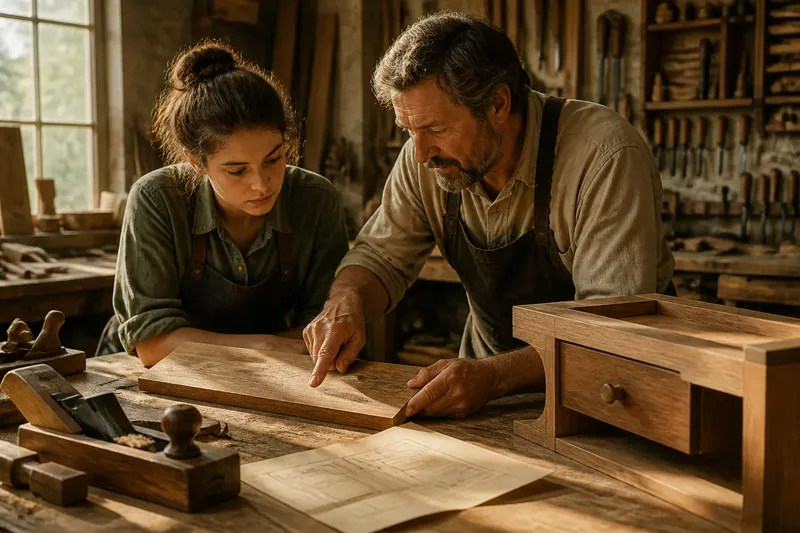
How did an apprentice learn to make a sound chair before a workshop had written instructions for every joint? Apprenticeship connected observation, practice, and responsibility through work that mattered. The details varied by craft, place, and period; the cabinet-shop scene below is an invented illustration, not a claim about every historical arrangement.
Imagine Mara, an apprentice in a small cabinet shop, arriving with basic hand-tool skills but little experience judging lumber. Her mentor, Elias, is making a writing desk for a customer. The desk is a way to examine how a learner might connect a decision to visible materials and consequences, not a historical record.
Apprenticeship placed observation inside the work
Mara’s first task is not to build a miniature desk. She watches Elias inspect boards, mark a cut, and set aside a piece with a twist. He explains that the warped board would make a poor top, then returns to work. The evidence is in front of them: the grain, the light across the surface, and the board’s position on the bench.
In this illustrative scene, the instruction includes both explicit rules and judgment that is harder to put into a sentence. Elias names the twist and points out where it appears. He does not narrate every movement. He draws Mara’s attention to the detail that changes the decision.
Watching by itself would leave a gap. A learner can copy motions without understanding what the craftsperson is attending to. Showing the cue alongside the choice gives Mara something concrete to look for the next time she handles a board.
Apprenticeship turned small tasks into participation
As Elias prepares the desk parts, Mara sorts boards by intended use and marks the pieces he has selected. She does not make the main cuts yet. If she chooses a board poorly, the error is limited and easy to discuss; if she chooses well, the shop has useful work. The task gives her a real role without placing the entire result in her hands.
For this invented shop, the tasks are divided according to what Elias believes Mara can handle. Preparing a surface, holding a piece steady, or checking a measurement may look modest. Each connects to a later stage, so the learner can see why care matters.
Mara marks a board from the wrong face. Elias catches the error before cutting and asks her to compare the mark with the drawing. Her measurement is correct, but she has applied it from the wrong side. She turns the drawing and board into the same orientation before marking again. The correction makes the relevant distinction visible: a sound measurement can still be used in the wrong frame.
Apprenticeship increased responsibility as judgment became clearer
As the desk takes shape, Elias asks Mara to fit a drawer front. He demonstrates the first adjustment, then watches her prepare the next one. Before the parts are fixed in place, he can inspect the fit. He also asks Mara to describe what she sees rather than simply say that the pieces seem close.
In the example, the task involves more than repeating motions. Mara must decide whether a surface is true, whether a joint needs adjustment, and whether a flaw can be addressed without weakening the work. Her progress is visible when she can notice a problem, describe it, and choose a sensible next action. Speed alone would not tell Elias whether she is ready to take on more.
Say Mara notices that one corner of the drawer front sits proud of the frame. She checks the fit from different angles, identifies the high spot, and asks Elias to confirm before she removes material. He agrees. She makes a careful adjustment, and the drawer face sits evenly. The observable result is a better fit, along with a clearer link between a visual cue and a controlled correction.
Apprenticeship made the finished work a shared measure
Near completion, Elias lets Mara fit the drawer and help prepare the surface. He keeps responsibility for decisions that could compromise the customer’s desk, but no longer directs every movement. In this invented scenario, the drawer slides cleanly and the finish looks even. Those results let the two workers discuss what Mara handled independently and where she still needed guidance.
One desk would not establish that Mara could handle every material or design. It would show a change in this particular job: she has moved from recognizing Elias’s decisions to doing parts of the work and explaining her own judgment. That is a more useful account of progress than declaring that she has finished learning.
The scene also depends on conditions that a tidy story can hide. Elias needs time to teach, Mara needs access to tools and materials, and the work must be divisible without putting the commission at undue risk. An apprenticeship arrangement is not automatically fair or effective. Its useful feature here is the close link between instruction and consequential work; its weakness is how much depends on the mentor’s judgment and patience.
What does apprenticeship teach about passing on craft?
Why was observation not enough?
Watching placed decisions in context, but doing the work showed Mara what those decisions required from her own hands. Elias also had to point out details she might not yet know to notice.
How did responsibility increase?
Mara began with bounded tasks, then took on work Elias could check before a mistake became difficult to reverse. In this example, the next task depended on the judgment she showed in the previous one.
What did the finished object establish?
The desk showed what Mara could contribute under the conditions of that job. It did not establish mastery of every material or design, but it gave both workers something specific to discuss.
What is not worth copying from old arrangements?
There is little value in preserving hierarchy or long hours merely because they may have existed in some apprenticeship settings. The useful elements in this illustration are demonstration, meaningful contribution, feedback, and responsibility that grows with demonstrated judgment.
Apprenticeship made learning answerable to the work
The cabinet-shop scene does not suggest that every craft should recreate a master-and-apprentice arrangement. It offers a narrower point: a learner can make progress when instruction is connected to visible work, useful tasks, and feedback. In this invented case, Elias and Mara can identify both what went well and what still needs supervision.
For anyone passing on a craft skill, the practical question is what the learner can take responsibility for next, and what observable result will help both people judge the work. That question keeps instruction tied to the task rather than to a claim of expertise. Apprenticeship craft knowledge becomes easier to discuss when decisions, materials, and consequences are visible together.